Across this A to Z collection, a network of recurring motifs emerges: movement, memory, routine, and the quiet relationships we form with the spaces around us. What began as a series of small walks, observations, and objects grows into a broader meditation on how place shapes experience. Many entries turn ordinary moments into points of reflection: the elevator ride that signals the start of a day, the weekly laundry walk marked by familiar sounds, the short trip to the fridge that becomes its own micro-journey. These small rituals reveal how walking is not only a means of getting somewhere, but a rhythm that structures daily life.
Another motif is the tension between familiarity and discovery. Buildings like Cowgill and areas beyond the borders of the hand-drawn campus map remind you that even well-traveled places hold surprises. Similarly, the desire path, the overlooked foil trash, and the confusing sign outside the New Classroom Building reveal how people continuously reshape their environment – sometimes consciously, sometimes without noticing.
Nature appears throughout as a grounding presence. The maple tree, the hiking trail, the nighttime Drillfield, and the open sky serve as moments where the world expands, offering stillness, perspective, or quiet companionship. These spaces contrast with the weathered concrete of Derring or the heavily used shoes, both of which bear the marks of time and movement, a reminder that places and objects age alongside their users.
Ultimately, the project traces a portrait of campus life not through grand landmarks, but through accumulated, ordinary moments. The main takeaway is how attentiveness transforms routine into meaning. Every walk, object, or overlooked corner becomes part of a personal geography: one that reveals who you are by how and where you move through the world.
A is for Alumni Mall
Prompt 2.15 Alumni Mall; Photograph and text; Friday, Nov. 7
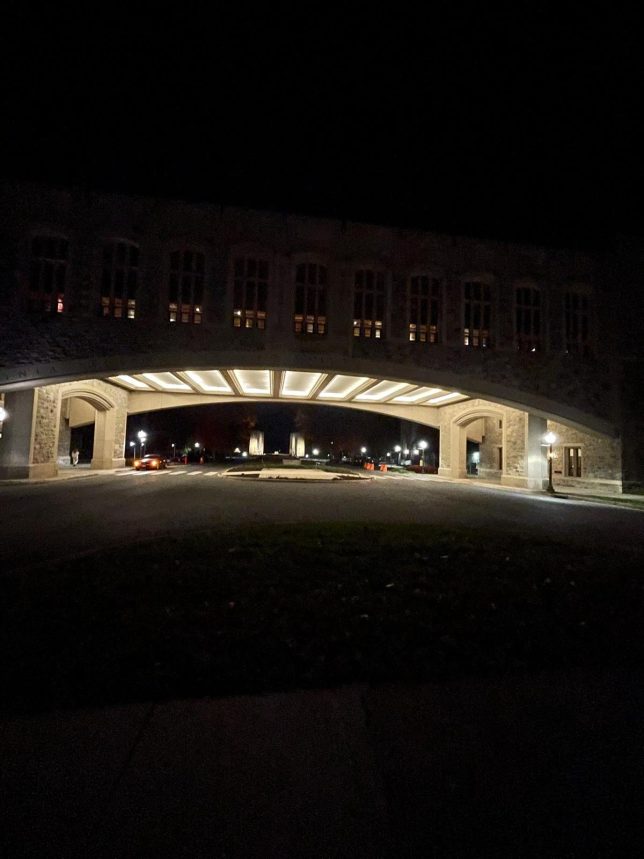
Figure 01. A nighttime view beneath an illuminated campus archway, showing the walkway framed by stone architecture and glowing overhead lights. (Original Photograph, Samarth Jain)
Under the arch’s warm glow, Alumni Mall feels like a long deliberate pause between destinations. Its boundaries seem to stretch from the quiet lawns to the steady columns of lights guiding each step, creating a corridor shaped as much by movement as by architecture. It’s called a mall perhaps because it invites strolling. I imagine that alumni return here not just to see a place, but to feel a memory: the echo of late walks, shared conversations, and the gentle pull of a campus that once held their daily lives. (90)
B is for Backpack
Prompt 2.23 The Things You Carry; Photograph and text; Friday, Oct. 31

Figure 02. A neatly arranged display of the contents of my backpack. (Original Photograph, Samarth Jain)
Spread across my desk are the everyday contents of my backpack: my notebook, pencil, pen, laptop, mouse, gum, and water bottle. These items follow me from class to class, shaping the rhythm of each day. My notebook carries quick thoughts and lecture notes. My pencil and pen mark ideas that come and go. My laptop and mouse form the core of my workspace, steady tools of focus. I also have a pack of gum and the water bottle, small comforts that keep me grounded amid the quiet frenzy of learning. (90)
C is for Cowgill
Prompt 2.07 What Even Goes On In There?; Photograph and text; Saturday, Oct. 18
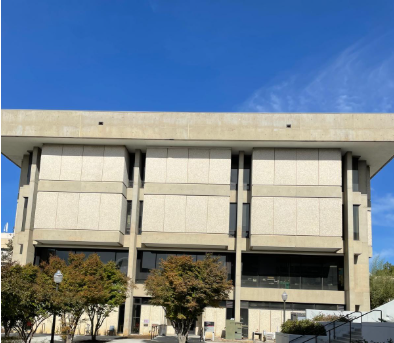
Figure 03. Cowgill Hall at Virginia Tech, showing its distinctive concrete facade and modern architecture under a clear blue sky. (Original Photograph, Samarth Jain)
I have always passed Cowgill Hall on my way from classes to the bus loops, and never stepped inside. I only noticed its concrete facade and activity through the windows. Today, I finally entered. Inside, I was struck by the mix of quiet focus and creative energy. The lobby displayed student artwork, and the hallways echoed with soft footsteps and low conversations. The hum of the printers added texture to the overall atmosphere. For once, I could see the collaboration and design work that give this building its lively energy. (90)
D is for Derring
Prompt 2.18 A Wish for Something to be Different; Photograph and text; Saturday, Oct. 18
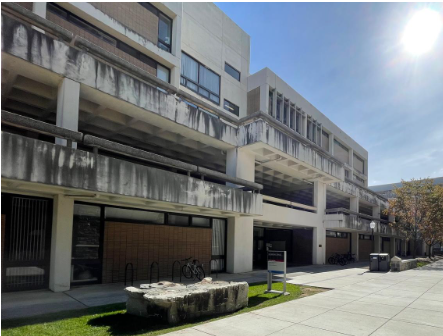
Figure 04. Streaked concrete walls of Derring Hall, Virginia Tech, showing dark discoloration and weathering. (Original Photograph, Samarth Jain)
Walking past Derring Hall, my attention is caught by the streaks of black grime staining the concrete walls, showing marks of age, rain, and neglect. The building is dulled by the weathering, turning what could be clean and modern into something weary and forgotten. I wish the walls could be restored – washed free of residue and sealed against future decay. It would take care, funding, patience, and a community effort to beautify this architecture again, so it could reclaim its beauty, architectural strength, and sense of place within campus life. (90)
E is for Elevator
Prompt 2.22 Stairs versus Elevator; Photograph and text; Tuesday, Oct. 21
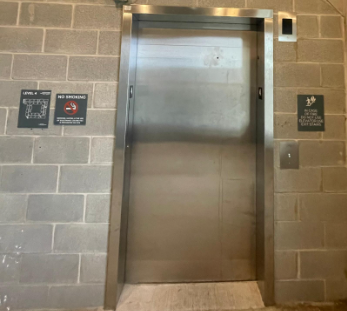
Figure 05. A stainless steel elevator door set within a cinderblock wall, framed by signage and minimal lighting in my apartment building. (Original Photograph, Samarth Jain)
This elevator sits just outside my apartment, a familiar gateway to the day. Every time I leave the building, I press the button, waiting for the quiet hum and the gentle slide of the doors. I do this often, riding down to the bus stop and to life beyond the building’s walls. Stairs feel unnecessary here, as convenience and ease win each time. Over time, this elevator has become a part of my daily routine, a small pause between comfort and motion, between home and the busy world around me. (90)
F is for Fridge
Prompt 2.32 Shortest Walk; Video and text; Friday, Oct. 31
Video 01. A video of the indoor walk from my room to the apartment refrigerator. (Original Video, Samarth Jain)
The walk begins as I leave my room. My roommate’s door is nearby, closed. The kitchen island stands still, solid. The apartment door is distant, untouched. The path curves sharply leftward. Light spills across smooth surfaces. I pass the counters on my right. Cabinets line the wall above. The fridge waits just up ahead, humming softly. Finally, I reach my destination and stop the video. The shortest walk exists, and takes only seconds to complete. I heat up my cold food in the microwave and walk back to my room. (90)
G is for Grass
Prompt 2.06 Talking Along the Drillfield; Photograph and text; Friday, Nov. 7
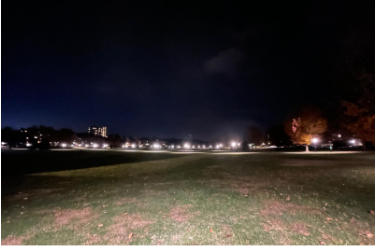
Figure 06. A wide, dimly lit expanse of the Drillfield at night, with scattered lights outlining the field’s perimeter and faint silhouettes in the distance. (Original Photograph, Samarth Jain)
Walking back across the Drillfield with my friends, the night felt wide and open, the grass stretching into darkness broken only by a ring of steady lights. We saw a few scattered figures crossing the field, their silhouettes small against so much space. Nothing seemed unusual, except how quiet everything felt – like the campus had paused. We didn’t choose a route so much as we drifted toward the easiest line across. I always associate the Drillfield with transition, friendship, and the strange comfort of an open clearing holding our conversations. (90)
H is for Hiking
Prompt 2.35 Go For A Hike; Photograph and text; Friday, Sep. 21
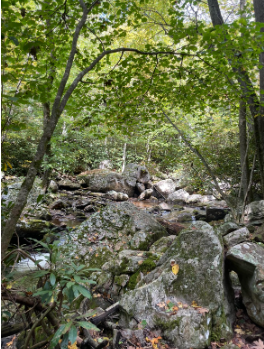
Figure 07. A forest scene along the Cascades trail, featuring dense greenery, layered rocks, and flowing water partially hidden beneath foliage. (Original Photograph, Samarth Jain)
I went on a hike to Virginia’s Cascade Falls, and the trail felt like stepping into a quieter world. The trees arched overhead, filtering the light into shifting patches across the rocks. Water moved somewhere just out of sight, its sound guiding me forward. Moss softened the edges of everything, as if time slowed here. I stopped often, not only because I was tired, but because the scene kept asking me to look again. Each turn felt like discovering a new pocket of calm, tucked gently into the giant mountains. (90)
I is for In the Night
Prompt 3.14 Star Gazing; Photograph and text; Monday, Dec. 1

Figure 08. A nighttime photograph showing a completely black sky, capturing the stillness of stargazing conditions. (Original Photograph, Samarth Jain)
Walking at night made everything feel different. I kept looking up at the sky, hoping to see stars, but the darkness was so deep that almost nothing was visible. Because I wasn’t watching the ground as much, I walked more slowly and carefully. I tended to pause in brighter or more open spots where I felt safe. The darkness made familiar places feel unfamiliar, quieter, and more serious. Without daylight, the whole walk became about noticing small sounds, gentle movement, and how much the night changes the world around me. (90)
J is for Journey Through VT
Prompt 2.01 Campus Map of the Imagination; Illustration and text; Saturday, Nov. 29
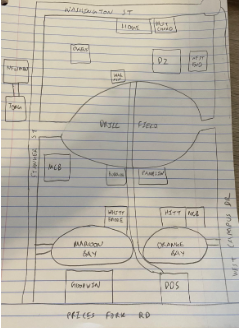
Figure 09. A hand-drawn map of the VT campus, from my memory. (Original Illustration, Samarth Jain)
My hand-drawn campus map captured only the parts of Virginia Tech I moved through most – on-campus dorms, dining halls, the Drillfield, familiar academic buildings. But when I walked with the map in hand, I reached an area I hadn’t drawn at all: a small pathway tucked between buildings, lined with trees I’d never really noticed. It reminded me how much of campus lives beyond my usual routes. The map showed my habits more than the place itself. What lay beyond its edges was everything I’d overlooked, waiting to be discovered. (90)
K is for Keeping on the Trail
Prompt 3.06 Draw a Map by Hand; Illustration and text; Saturday, Nov. 29
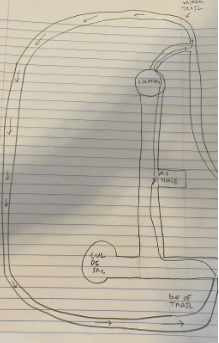
Figure 10. A hand-drawn map of my neighborhood trail that I frequently walk on. (Original Illustration, Samarth Jain)
Mapping my favorite home trail by hand made me notice the life it holds. The path winds through woods and crosses a stream on concrete stepping stones, where I often spot fish darting beneath the water and turtles basking on logs. Snakes slither quietly along the banks, while foxes and deer occasionally appear in the underbrush. I sketched bends, benches, and sunlit clearings, trying to capture both the route and the creatures that share it. Each line and symbol reflects not just the trail’s shape, but the living rhythm of this familiar path. (90)
L is for Laundry
Prompt 2.12 Indoor Walk; Illustration and text; Tuesday, Oct. 21
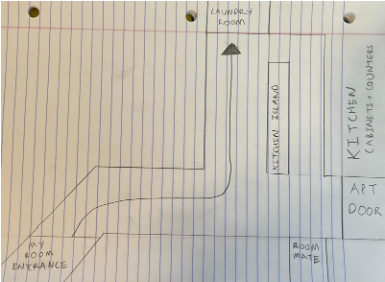
Figure 11. A hand-drawn floor plan of my apartment showing the path of the indoor walk from my bedroom entrance to the laundry room. (Original Illustration, Samarth Jain)
Every Sunday, I go on an indoor walk from my room to the laundry room – an unnoticed ritual. The path curves gently near the kitchen island, its smooth marble surface reflecting daylight. On my journey, I see the kitchen cabinets and counters, lined with half-forgotten dishes and the faint smell of food. Each step feels familiar, steady, and quietly meditative. Inside the laundry room hums the washing machine and dryer, their rhythm steady and comforting. This short journey, repeated weekly, anchors my routine in the quiet pulse of my apartment. (90)
M is for Maple Tree
Prompt 2.05 A Good Bench; Photograph and text; Saturday, Oct. 11
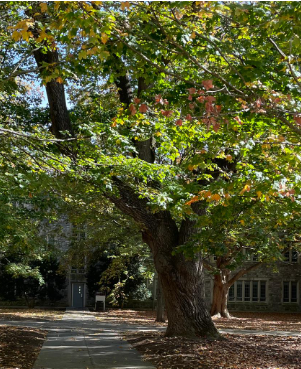
Figure 12. A large mature maple tree stands in front of the back entrance of Williams Hall at Virginia Tech. Its branches stretch wide across the walkway. The afternoon sunlight filters through the leaves, casting shadows across the path below. (Original Photograph, Samarth Jain)
Dear Maple Tree,
Your sprawling branches and vibrant leaves brighten the path to Williams Hall, creating a canopy that welcomes all who pass beneath. In autumn, your leaves shift from bright green to warm orange and red, reminding me of change and resilience. You stand tall and steady, a quiet guardian on campus, sheltering students and visitors. Among countless trees, you feel special – both strong and graceful. Thank you for your shade, your colors, and your silent companionship through every season’s turn. You make this place feel alive.
Sincerely,
Samarth (90)
N is for New Classroom Building
Prompt 2.14 Signage; Photograph and text; Friday, Oct. 10
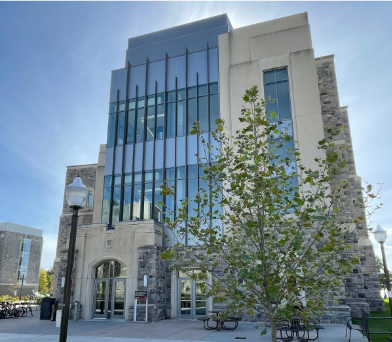
Figure 13. The New Classroom Building at Virginia Tech, showing its modern architecture with stone walls and reflective glass windows. This photo captures the numerous seating areas and vegetation at the front of the building. (Original Photograph, Samarth Jain)
On my walk, I noticed that the sign outside New Classroom Building read “Classroom Building.” The mismatch struck me each time I passed it – was the “new” informally tacked on by students who remember when the building was built? The plain white letters on a dark background tried to project clarity, yet the missing “New” made the message seem oddly incomplete. It felt like the sign had not caught up with the building’s identity, or maybe the building itself hadn’t yet earned its “newness,” still waiting to define itself fully. (90)
P is for Passing Clouds
Prompt 2.03 Overhead at Time of Day; Photograph and text; Wednesday, Nov. 26
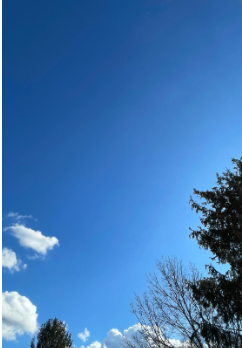
Figure 14. A clear-sky scene framed by evergreen and leafless trees, with bright clouds drifting across an open expanse of blue. (Original Photograph, Samarth Jain)
I stop on the path and look up, letting the sky fill my view. For thirty seconds, I focus on its wide, bright blue. The sky feels close but also huge, stretching far beyond what I can see. The soft white clouds move slowly, like they are floating on a calm sea. The blue light shifts gently, reminding me that the troposphere is always changing. Just like in language, one shape becomes another. This photograph helps me hold onto the brief moment when the sky seemed both peaceful and alive. (90)
R is for Reflection
Prompt 3.01 Reflective Preparatory Writing; Photograph and text; Saturday, Oct. 11
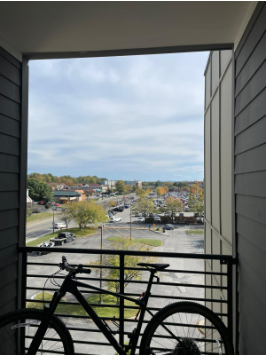
Figure 15. A balcony view overlooking a busy street, framed by building walls and a bicycle in the foreground. (Original Photograph, Samarth Jain)
I walk because it calms my mind and helps me feel present. Stepping outside feels like opening a window inward, letting in clarity I rarely find indoors. I usually walk through familiar streets like the one below – cars moving steadily, trees shifting color, and people following their own routines. I hope to explore quieter, wider paths someday, places where I can hear my footsteps clearly. My pace shifts with my mood, slow when reflecting and faster when seeking energy. I usually walk alone, guided by steady footsteps through each day. (90)
S is for Shoes
Prompt 2.02 Shoe Portraits, Shoe Memories; Photograph and text; Monday, Oct. 20
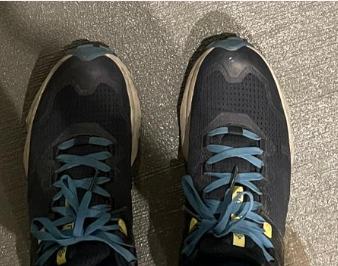
Figure 16. A pair of well-worn waterproof hiking shoes, showing creases, dust, and the marks of many miles walked and environments traveled. (Original Photograph, Samarth Jain)
The pictured shoes have carried me through countless days – up steep campus hills, across damp sidewalks after sudden rain, and through deep Alaskan snow that once soaked the laces stiff. The soles are worn thin in familiar places, a quiet record of movement and routine. Each scuff tells a story: early morning walks, late-night excursions, and everything in between. They have traveled more miles than I can count, steady companions molded to my pace, my rhythm, and my daily journey through work, reflection, and the shifting seasons of student life. (90)
T is for Trek to Wellness
Prompt 2.13 Step Counting Metrics; Photograph and text; Tuesday, Nov. 25
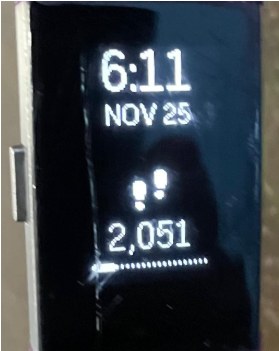
Figure 17. A Fitbit step counter displaying time, date, and a total of 2,051 steps. (Original Photograph, Samarth Jain)
For this walk, I used my Fitbit step-tracker and set out for a short, focused route. I watched the numbers climb slowly, each vibration reminding me the device was counting even when I wasn’t consciously thinking about it. I feel neutral toward step-tracking. It can be motivating, but sometimes it feels like pressure. My walk was simple, though the tracker lagged once or twice. I know people who treat their daily step goals like a sport, but I prefer using mine gently, as a loose guide rather than a rule. (90)
U is for Undergraduate Science Laboratory Building
Prompt 2.05 A Good Bench; Photograph and text; Friday, Oct. 10
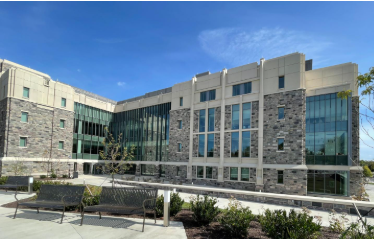
Figure 18. The Undergraduate Science Laboratory Building at Virginia Tech, showing its modern architecture with stone walls and reflective glass windows. This photo captures the back of this building, revealing an outdoor seating area on a bright sunny day. (Original Photograph, Samarth Jain)
Sitting on the benches outside the Undergraduate Science Laboratory Building invites a brief moment of calm during a busy walk. The smooth metal benches have gentle curves that provide comfortable support but face away from the building and towards the parking lot and the road beyond. This orientation creates a different kind of view – cars, pedestrians, and campus activity – inviting quiet reflection on movement and transition rather than architecture. A good bench balances comfort, accessibility, and connection, even when the surroundings are utilitarian, making rest both practical and thoughtfully refreshing. (90)
V is for Virginia Tech Hoodie
Prompt 2.34 Directions for a First-year Student; Photograph and text; Wednesday, Nov. 26

Figure 19. A maroon Virginia Tech hoodie featuring the university’s name in orange lettering. (Original Photograph, Samarth Jain)
Dear Future Hokie,
Welcome to Blacksburg! One of your first treasures should be a piece of VT merch – like the maroon hoodie every Hokie seems to own. It’s more than clothing; it becomes your armor against windy Drillfield days and your badge of belonging. Start your campus journey there, where every path crosses. Go to Newman Library when you need focus and to Dietrick Hall when you need fuel. And don’t miss a sunset from the pylons. Wrapped in Hokie colors, campus will start to feel like home.
Sincerely,
Samarth (90)
W is for War Memorial Chapel
Prompt 2.28 War Memorial Chapel; Photograph and text; Friday, Nov. 7
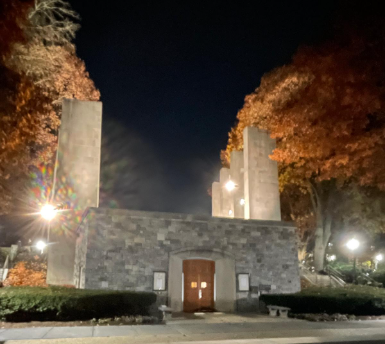
Figure 20. The Pylons at Virginia Tech illuminated at night, framed by autumn foliage and campus lights. (Original Photograph, Samarth Jain)
When I was coming back from an event, I approached War Memorial Chapel from the Drillfield. Its lower doors set quietly into the stone as though inviting you to step down. Inside, I’ve wandered only briefly – enough to feel the hush of the space and its intention for reflection, remembrance, and ceremony. The rooftop, crowned by the pylons, feels completely different: open, elevated, a place where values are etched into the wind. Each visit reminds me that the building holds both memory and perspective, grounding and lifting you at once. (90)
Y is for Your Path
Prompt 2.17 Desire Paths; Photograph and text; Monday, Dec. 1
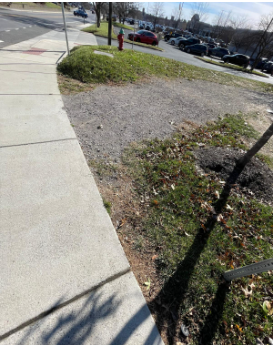
Figure 21. A lightly worn desire path cutting across a grassy area beside a sidewalk, marked by bare gravel where repeated foot traffic has carved an informal route. (Original Photograph, Samarth Jain)
The desire path shown curves off the sidewalk as if impatience itself had etched it into the earth. Students clearly decided the official route wasn’t the most efficient – maybe they were rushing back to their apartments and didn’t want to take the elevator, avoiding crowds, or simply choosing the shortest line between two points. Over time, their choices merged into this shared trail, a quiet record of collective preference. It reveals something simple but true. People will always shape their environment to fit their movement, not the other way around. (90)
Z is for Zero Excuse
Prompt 2.24 A Meditation on Garbage; Photograph and text; Monday, Dec. 1
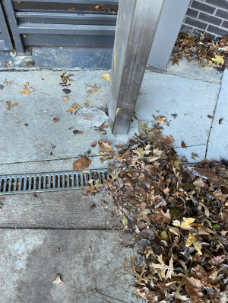
Figure 22. A small piece of crumpled foil lying beside a metal post and drainage grate, partially surrounded by fallen autumn leaves on a concrete walkway. (Original Photograph, Samarth Jain)
The small piece of foil tucked against the metal post seemed almost swallowed by the pile of autumn leaves around it. It likely drifted there – carried by wind, rain, or hurried footsteps – rather than being intentionally discarded. Its presence made me reflect on how Virginia Tech generally maintains clean, orderly outdoor spaces, yet small bits of trash still gather in overlooked corners. Most Hokies appear mindful of keeping campus tidy, but moments like this remind me that environmental stewardship depends on constant, shared attention, even in the smallest, low-stakes places. (90)