Before beginning this project, I never thought of myself as someone especially tuned into my surroundings. I walked to class the same way every day, more focused on where I needed to be than on what I was passing along the way. But the Walkings project forced me to slow down, to look up, to notice things that usually slip by unacknowledged. One of my main takeaways from this project is that the world is so much more interesting when you stop assuming that there is nothing new to see. ‘
In these entries, there was a recurring theme of alignment, not just visually symmetrical but when unrelated items come together for a brief moment in a way that looks like it could have meaning; for example, flags being framed by trees, clouds forming temporary shapes. Other times it was more abstract, like the exit 460 signs asking me a question. Without taking a second to step back, and think about your surroundings, most of these moments would go unnoticed.
Another repeated theme is stillness versus movement. This contrast appeared in the slow drift of a twig at Duck Pond, the soft tapping of my shoes on the sidewalk, the quiet steadiness of the War Memorial Chapel, and even the loud splash of the Cascades waterfall, where constant motion and sound made the area with friends feel calming. Walking allows me to move through these spaces and experience the surroundings without having to stop and take a look around myself.
Most of all, this project taught me that walking allows for more thinking time. Each entry became a small testament to me paying more attention to my surroundings and displayed that meaning can hide in ordinary moments if I’m willing to notice them.
A is for Alignment
X.XX Unprompted; Photograph and text; Saturday, November 8th
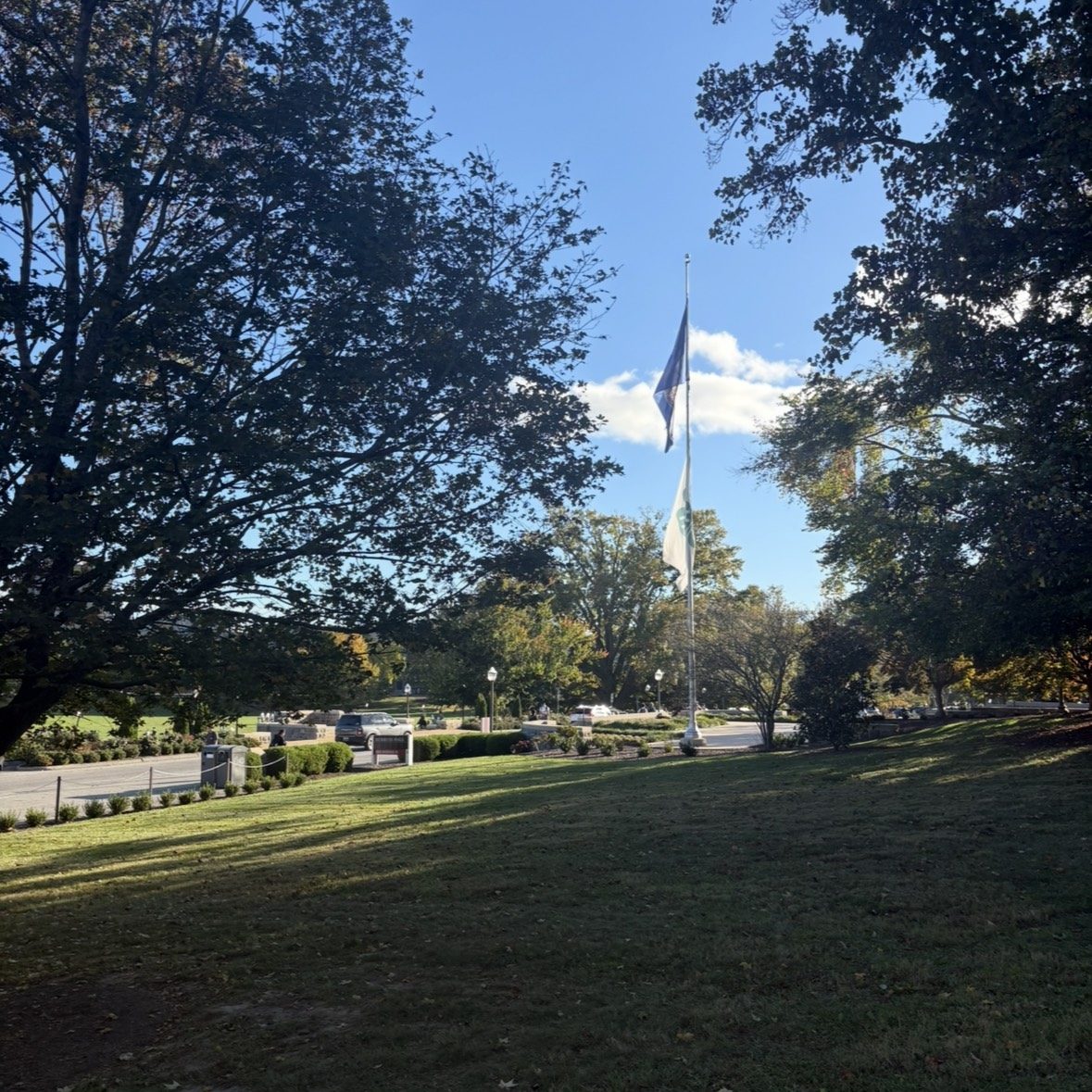
I captured this moment because this shot was so well aligned that I couldn’t help but take a picture. As someone who is not too conscious of their surroundings, I don’t usually see these types of “picture perfect” moments. Here, the Virginia state flag was almost perfectly centered within the space formed by the two trees, as though the trees purposely wanted to create a frame around the flag and draw attention towards that image. In addition, the way sunlight came through the clouds and the trees made the flag appear vibrant blue against the white sky. In fact, the clouds were perfectly positioned to create a clear background for the shot. The lawn in front of me was sloped in a way to give the picture a staging area. I remember thinking how still everything felt, even though I was only there for about 20 seconds. Branch shadows stretched long across the grass, almost pointing toward the flagpole as if acknowledging its place in the moment. Nothing extraordinary was happening here, and maybe that was why I liked it. (180)
B is for bench
2.05 A Good Bench; Photograph and text; Friday, Oct. 3rd
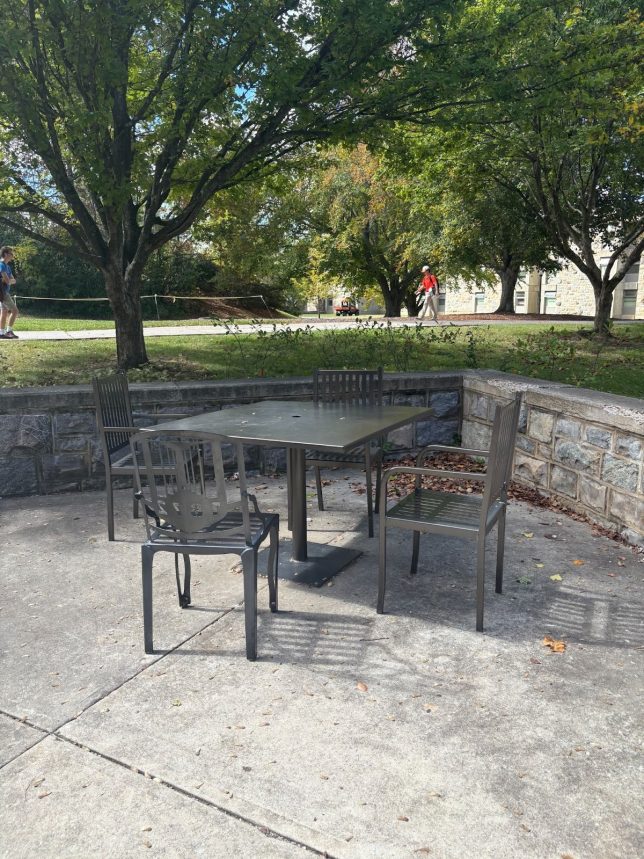
I find these chairs waiting, empty but almost as if they are expecting someone. Their shadows touch like they’re holding hands. Sitting here, it feels like my senses are magnified tenfold. I hear people walking by, leaves brushing against each other in the trees, and a door closing on my left. A good bench (this one), lets you slow down and look around. These four chairs could hold a whole group, but their emptiness makes the space calm. For a moment, my walk takes a break, and so do I. (90)
C is for Cloud
2.03 Overhead at Time of Day; Photograph and text; Monday, Oct. 27th

I stop walking and look up. The clouds feel closer than they normally are, thin like cotton and stretched too far cotton candy. The sky behind them is a royal blue, a color so familiar but impossible to remember where it’s from. I’d guess the clouds are a mile above me, maybe less, but distance feels incalculable when everything is moving. Shapes melt into new shapes: a letter, a wave, a pitchfork. The sky changes faster than thought. The clouds continue to move…turning one form for another, as if adapting. (90)
D is for desire
2.17 Desire Paths; Photograph and text; Wednesday, Oct. 8th
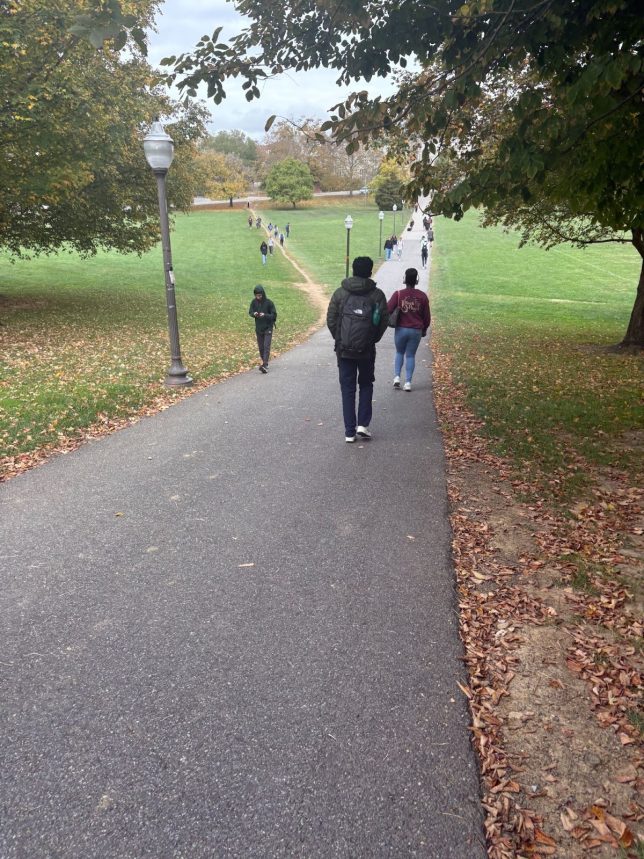
this path wasn’t planned, it was wanted. Worn into being by those who refuse to walk the long way, a difference of seconds, it stretches across the Drillfield like a stained plate. When the sun’s out, the dirt dries to dust, marking the rhythm of daily steps. But when it rains, the same path drowns, unused and lonely, its life sinking into mud. Still, it waits for the next stretch of dry light. Or maybe, for a better use of words, it has a desire to feel footsteps once more. (90)
E is for Exit
X.XX Unprompted; Photograph and text; November 21st
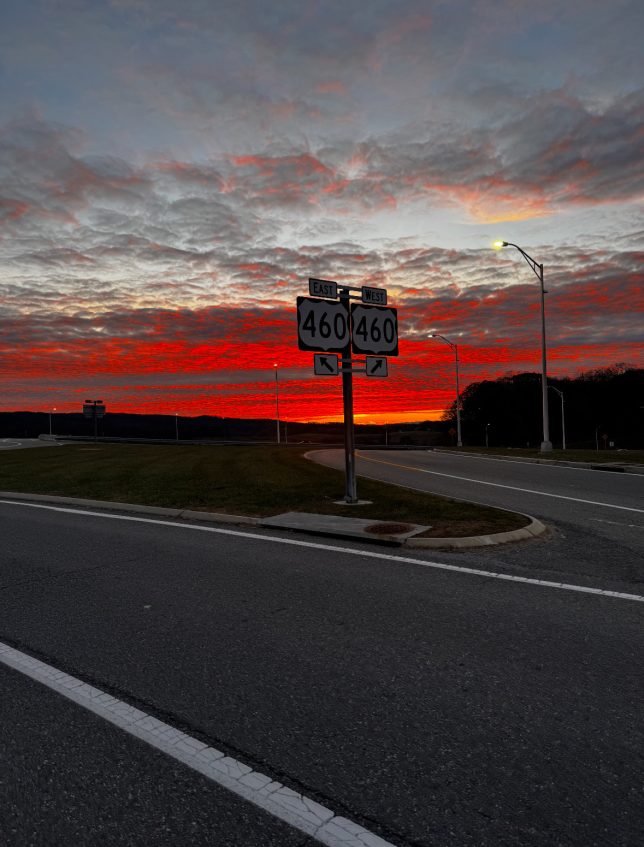
The sky looked surreal here, the stacked layers of orange to yellow to red as if the horizon itself had caught fire. I was leaving Tech for Thanksgiving break, heading north on I-81, when this moment suddenly appeared at the exit. The 460 sign, never really standing out, stood sharply against the bright sky, pointing east and west as if giving me an ultimatum. For a moment, the road felt like it was asking me a question of where I was going, not just physically, but in my future. (90)
F is for Fire Hydrant Pipe
X.XX unprompted; Photograph and text; , Wednesday, November 17th
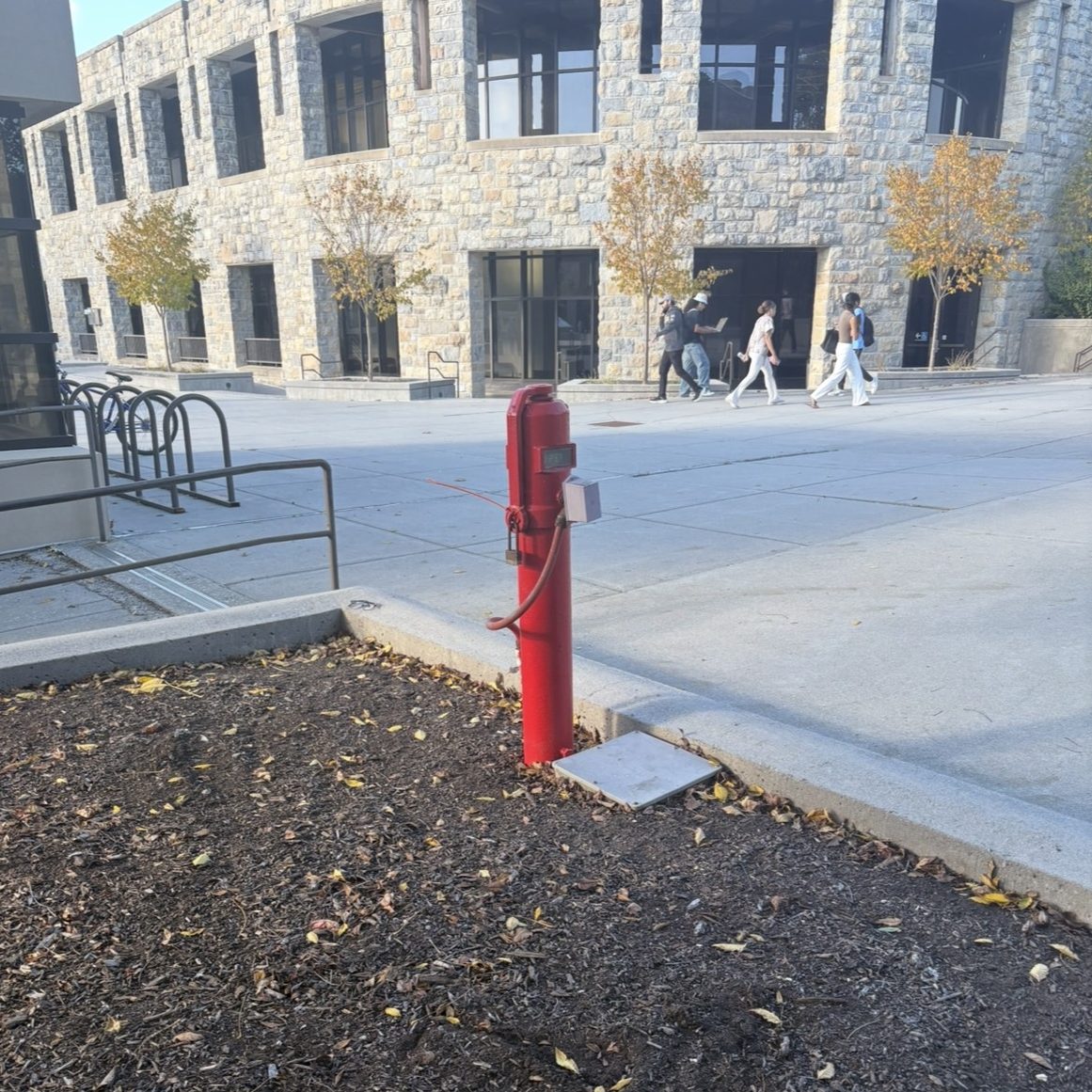
I pass this location almost every day, but for some reason I have never noticed the fire hydrant (if it is a fire hydrant) until now. Perhaps, because of how much it sticks out from its surroundings: the gray Hokie stone buildings, the smooth gray concrete sidewalk, and the brown mulch located beside the hydrant, it somehow blended in. The bold red color of the vertical cylinder, as striking as an exclamation mark within a sentence. The paint has some chips and the metal attachments are showing signs of wear, but the red color shines through.
Many people walk by this space, traveling to their classes, talking with friends, adjusting backpacks, and showing no attention to the fire hydrant at all. However, despite this fact, the fire hydrant stands proud and vigilant in the middle of the two buildings. The afternoon sun hits the fire hydrant straight on, creating a slight reflection off the red paint. The shadows of the objects surrounding the fire hydrant appear to be leaning away from the fire hydrant, enabling it to take center stage. (180)
G is for Grass Covered in Snow
X.XX unprompted; Photograph and text; Monday, November 10th
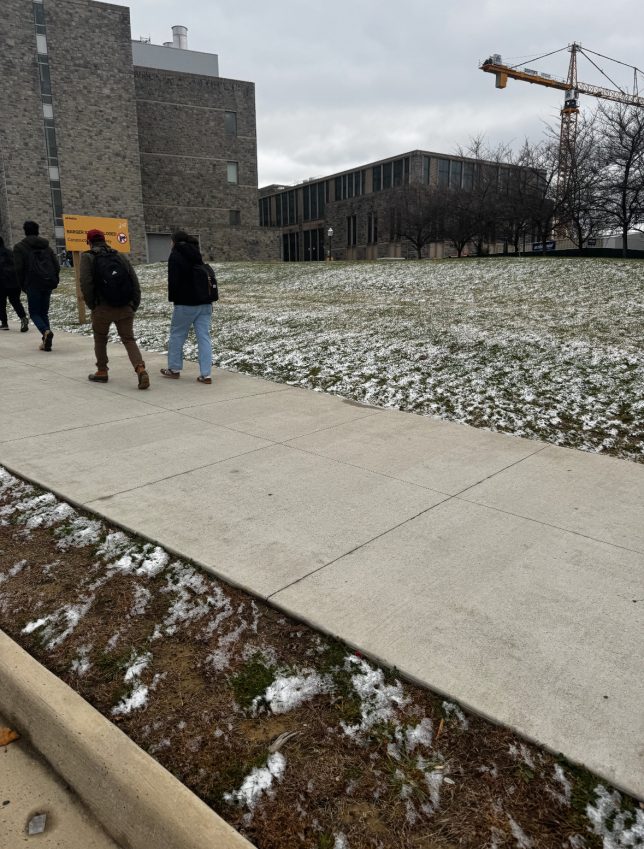
Not much snow came, just a thin layer scattered across the grass, unfortunately not enough to close school. Outside Orange Loop, the spread of snow was very uneven. covering some areas white while leaving others green. Students walked past paying little attention, I paused for a second though, because this scene was the first small sign of winter. It wasn’t much of a change, but it reminded me that colder days are coming soon, and it may be a good idea to bring my puffer back to Tech after break. (90)
H is for Hike
2.35 Go For A Hike; Photograph and text; Sunday October 26th
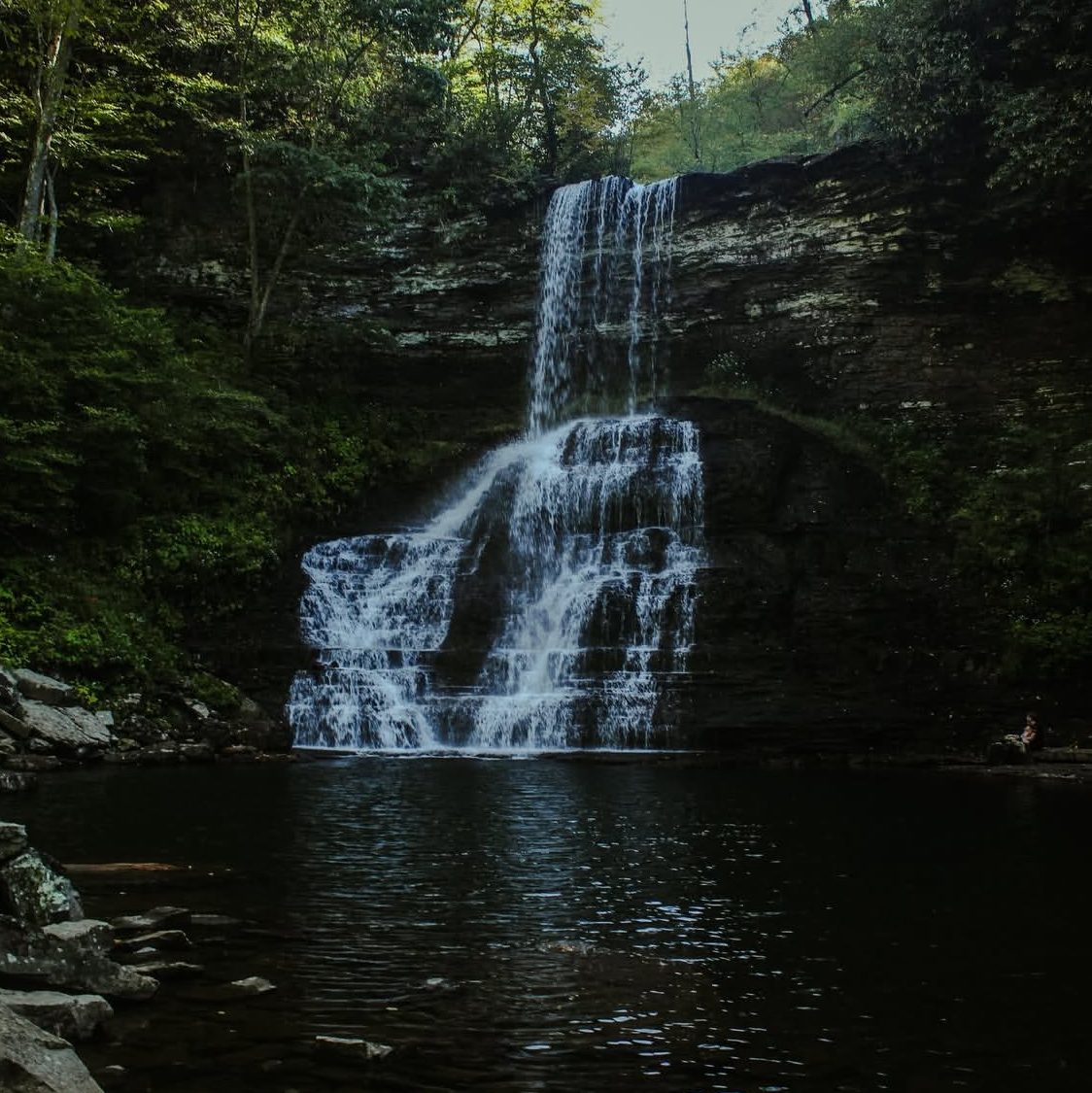
As soon as you step foot onto the trail leading to the Cascades, it immediately feels alive, roots clutching at the earth, rocks aged with the passage of time, and a babbling creek moving alongside you that will always guide you. I hiked with friends, all of whom had varying experiences and expectations going into the hike, but all of whom were also in awe of what we found. The trail itself was not physically demanding, but still had our full attention throughout. When we finally saw the waterfall, it appeared like it had been poised for our arrival. The water tumbled in tiers, white against dark rock, dropping into a pool cold enough to make you gasp. We sat on nearby scattered boulders, very little was said, it didn’t feel like a place where you converse, it’s a place to look, to breathe, to be still. I hiked back slightly drenched in sweat and water. While not to sound corny, after the hike, I realized it really was not about the destination, rather the the journey with my friends. (180)
I is for items
2.23 The Things You Carry; Photograph and text; Monday, November 15th
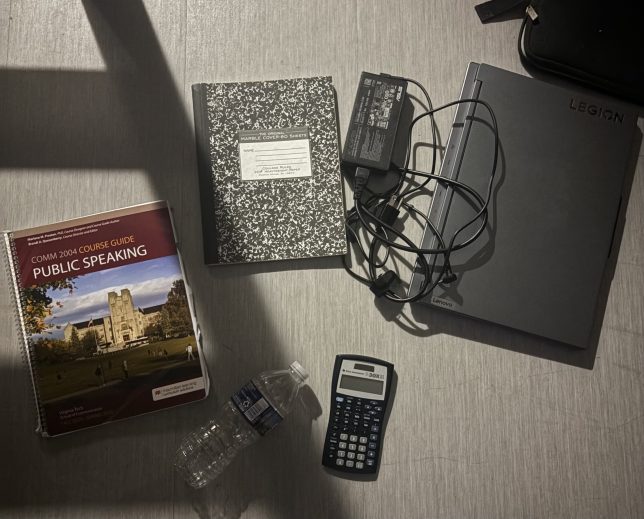
Figure 09. Contents of my backpack arranged on the floor, ranked in order of necessity. (Original photograph, Yadel Gezehagne)
Here lies my empty backpack, along with its items, ordered by most essential to least.. The most important item in my backpack is my laptop, the focal point for every assignment, class, and ultimately the late-night race to finish many assignments before the deadline. It has always been the focal point of my backpack. Secondly, my laptop charger, as my laptop would have no purpose without its charger. The third item in my backpack is my math notebook. My math notebook contains answers to math problems that are not yet complete and notes that made sense when I wrote them but incomprehensible when reviewing. The fourth item is my communications workbook. The writing in my communications workbook contains notes, reminders written in the margin, and peer critiques not yet to be finished. The fifth item is a calculator, an older style calculator but still operational and quick. The last item in my backpack is an empty water bottle, rolling loosely at the bottom of the bag, a quiet reminder that I should probably drink more water than I actually do. (180)
L is for Litter
2.24 Meditation on Garbage; Photograph and text; Wednesday, Oct. 1st
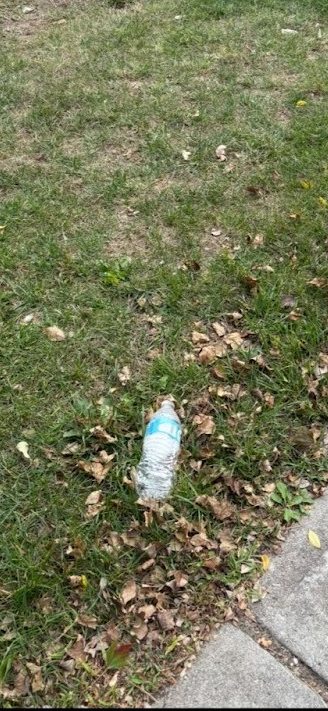
Once, it held water and had a sense of purpose, bought in bulk and drank for convenience. Now it lies forgotten, cradled by dead leaves like a cheap coffin. The grass bends around it, a quiet burial for something that will live too long. Wind nudges it, but the leaves hold it firmly in place. The label still intact, tossed probably just within the day, just fifty feet from the nearest bin. Even trash finds a place to settle, not at its home, but rather what the world left behind. (90)
M is for Memorial
2.27 4/16 Memorial; Photograph and text; Tuesday, Oct. 28th
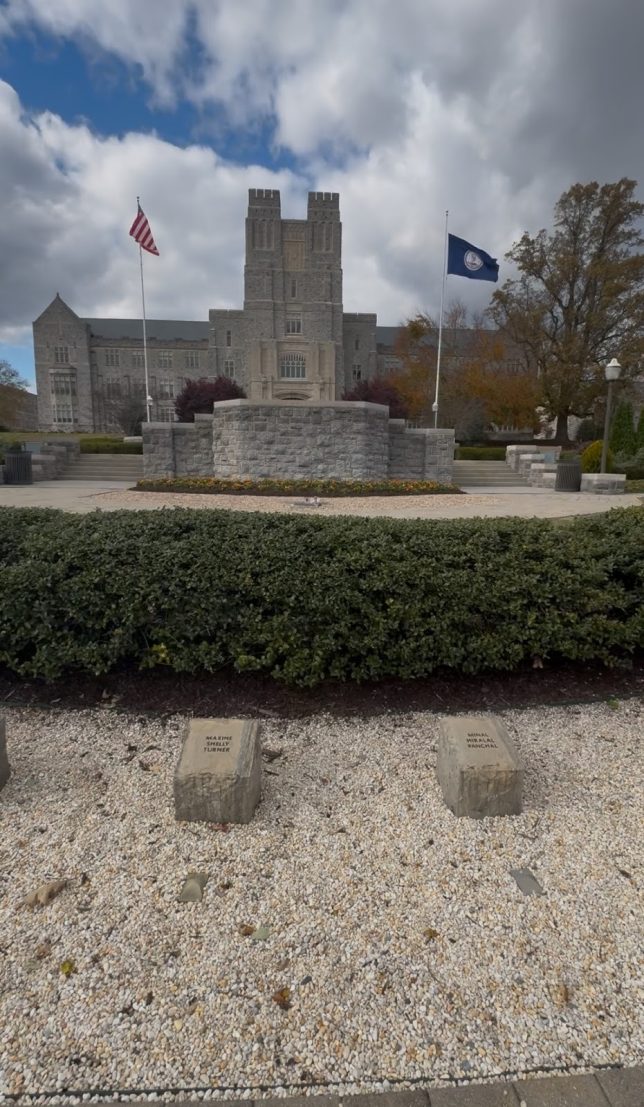
This memorial isn’t similar to typical ones, there’s no statue rising upward, no grand platform, and no attention stealing features. Instead, there is a circle of individual stones, each name of a person lost given its own space. The simplicity is what stands out: nothing towering, nothing polished, just gray engraved stone. The single arc of these stones allows people to walk through and read the names of those lost. It feels less like a monument built to be looked at and more like a place meant to be felt. (90)
N is for Newman Library
2.29 Public Library; Photograph and text; Monday, Oct. 20th
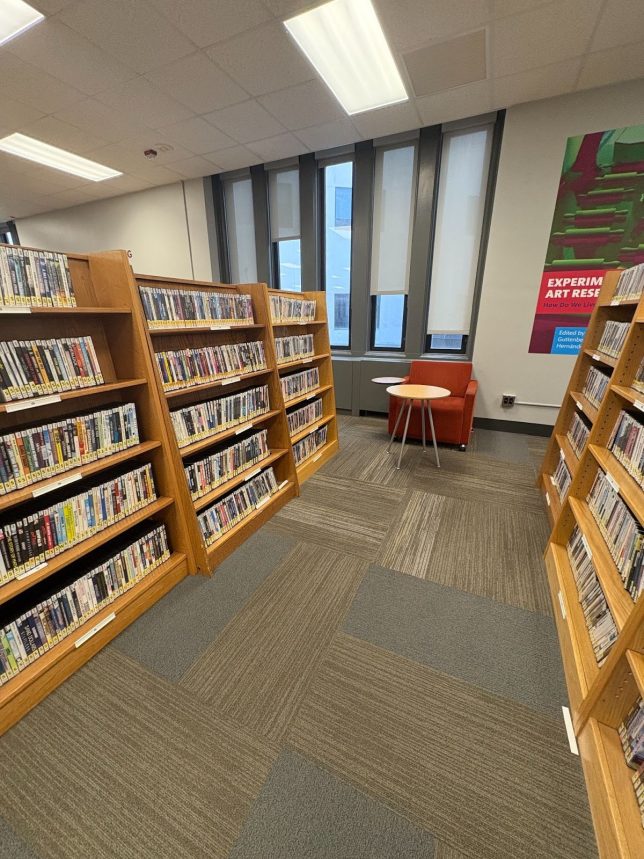
Libraries have always felt calming, places where noise is minimal and the mind gets to rest. I’ve used them for studying, escaping, even wandering aimlessly through shelves until something unexpected found me first. They hold the possibility for your mind to escape. Today, I picked up Four Thousand Weeks. An old book I’ve read, but wanted to re-read as days have felt stressful lately. So I settled into a quiet corner, hoping the book’s gentle but firm reminder of our four thousand weeks on earth would help me slow down. (90)
P is for Path
2.21 Blacksburg’s Best Walk; Photograph and text; Monday, Sept. 29
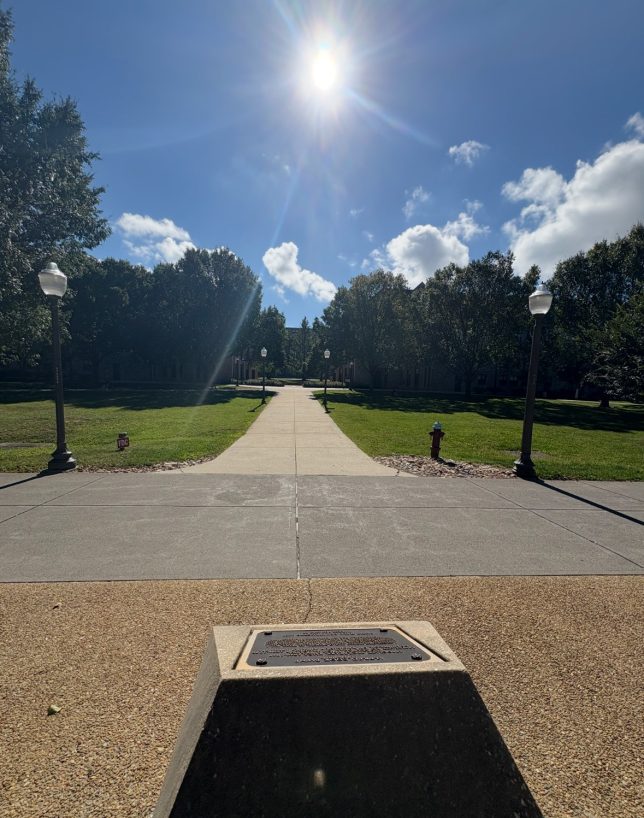
George calls this Blacksburg’s best walk. Interestingly enough, I see why. No matter the season, the scene feels very calm. The trees lean gently toward each other, like old friends meeting halfway. Ahead, laughter drifts from the Prairie Court, with voices softened by distance. The path itself feels very familiar, but I have never walked it. Here, walking this path for the first time, time seemed to slow down. The world feels nicer, the air clearer, and the light posts glare down at me, as if asking me to stay. (90)
R is for Roundabout
2.18 A Wish for Something to be Different; Photograph and text; Monday, Oct. 6th
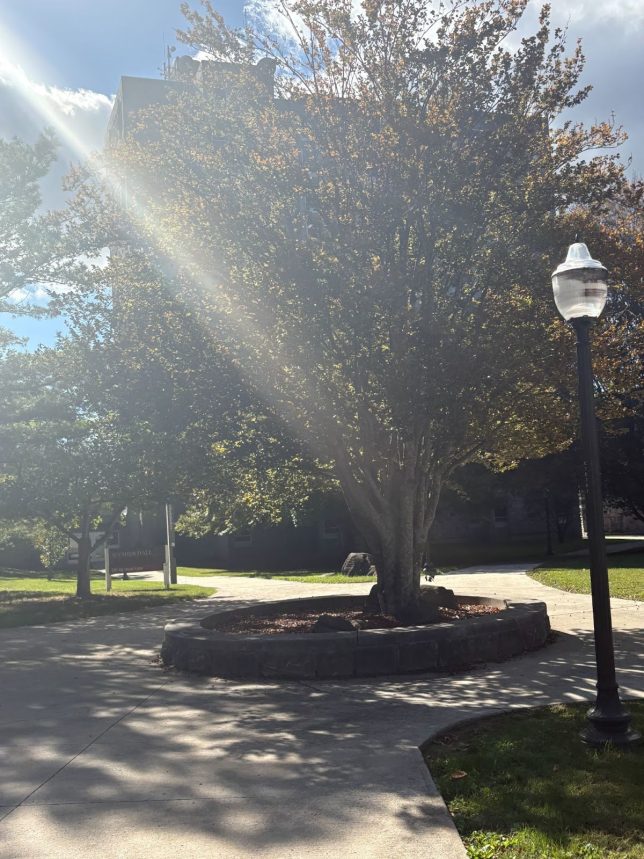
At this roundabout of paths, symmetry tries, and fails, to hold. The circle’s center isn’t centered, the tree drifts right slightly off center. Each sidewalk meets the center unevenly, almost as if they are hesitating, uncertain which direction is correct. I walk, wondering if this imperfection was accidental. Maybe it mirrors people, as we have our own off-center movements through life. Still, I imagine smoothing the lines, reshaping the circle, centering the tree. I never noticed this asymmetry, in fact, I loved taking this path. Maybe beauty doesn’t need balance. (90)
V is for Virginia Tech Football
2.04 Overheard, Less Context; Photograph and text; Saturday Nov 1st
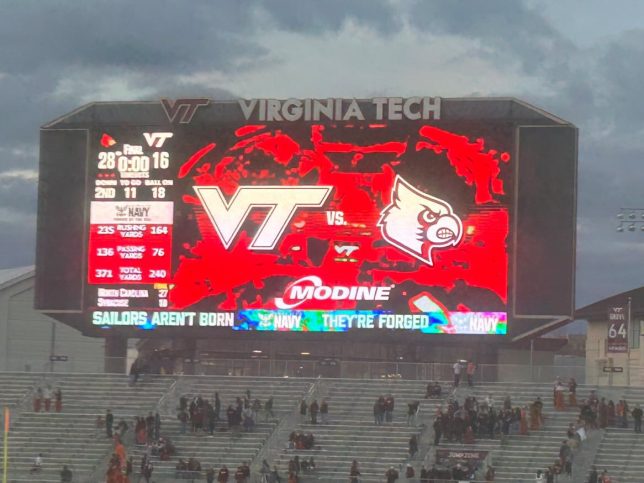
In the center of the bleachers, halfway from the turf to the sky, I realized something was different this game. The score of Louisville winning 28 – 16 likely registered as only another loss for Virginia Tech to most. However, to me, the score held more weight than just that. Louisville is a solid team, everyone around me clearly knew that fact. There were multiple conversations about all the prior events that had transpired to bring Virginia Tech to this point in college football. During the fourth quarter, I listened to the comments of people around me. While disappointment was continuously expressed, there was no mention of anger, no comments about being outraged, but rather acknowledgement that the team had felt off for a while.
Eventually, I overheard an older man sitting in front of me say, “There’s only so much Montgomery (our coach) can do at this point.” And that’s when it clicked why Coach Pry had been fired two months earlier. I never had much understanding as to how much a coach contributes to the success of a football team and how our team’s current state could be attributed to Pry. But seeing everyone’s reaction to this game, although a loss, put into perspective how deeply leadership shapes the direction of a team. It wasn’t just about the score, it was about the feeling that a program is moving somewhere.
Standing there, surrounded by the sighs of students and alumni, I understood that our coach change was a necessity. Football programs at this stage either move forward or fall behind, and the crowd around me sounded ready to move. (270)
S is for Shoes
2.02 Shoe Portraits, Shoe Memories; Video and Text; October 30th
https://drive.google.com/file/d/1C1F2s3l9y3zWb6Db3lNO-Ai-H-5uDdiW/view?usp=sharing
Figure 16. Video of white Under Armour sneakers walking gently against the sidewalk, echoing like distant track spikes with softened impacts. (Original video, Yadel Gezehagne)
These shoes are still new, bright white, and barely creased. Someone complimented them the first week I wore them, and ever since, they’ve been my favorite. They make a sound like track shoes on concrete, but quieter. That soft tapping keeps pace with my walk, slightly annoying but comfortable. They’ve carried me across campus, through the mud on the drill field to sand on the volleyball courts. Not flashy to me (but maybe to others), just reliable, and that’s exactly what I need from a pair I wear every day. (90)
T is for Twig
2.19 Duck Pond; Photograph and text; Monday, November 8th
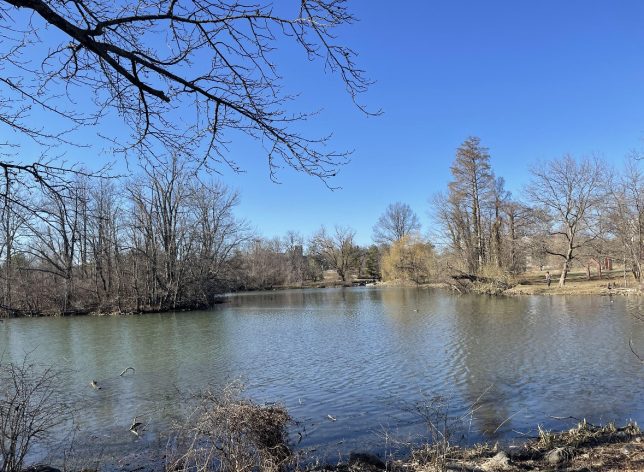
At first gaze, the duck Pond looks very serene, a large body of water, little foot traffic, and dots of people scattered around like sprinkles on a donut. Today I noticed an object most would overlook, it was a single twig floating in the water in front of me. The twig itself had a bend or two and it drifted slowly across the pond. The ripples created by the twig’s movement caused it to bob up and down but did not disturb the twig’s ability to remain upright.
While I sat there watching the twig I noticed that there were not many people around me. The only other living thing I saw was one duck, drifting along the pond, leaving a straight ripple trail behind itself. As the duck glided past, the twig continued its slow, intriguing drift, moving across unhurried, guided only by the gentle pull of the water. Its slow pace, although uneventful, felt really calming, and it’s contrast to the duck made me realize how peaceful it can be when something simply moves at its own pace. (180)
U is for Underpass
2.21 Blacksburg’s Worst Walk; Photograph and text; Thursday, November 13th
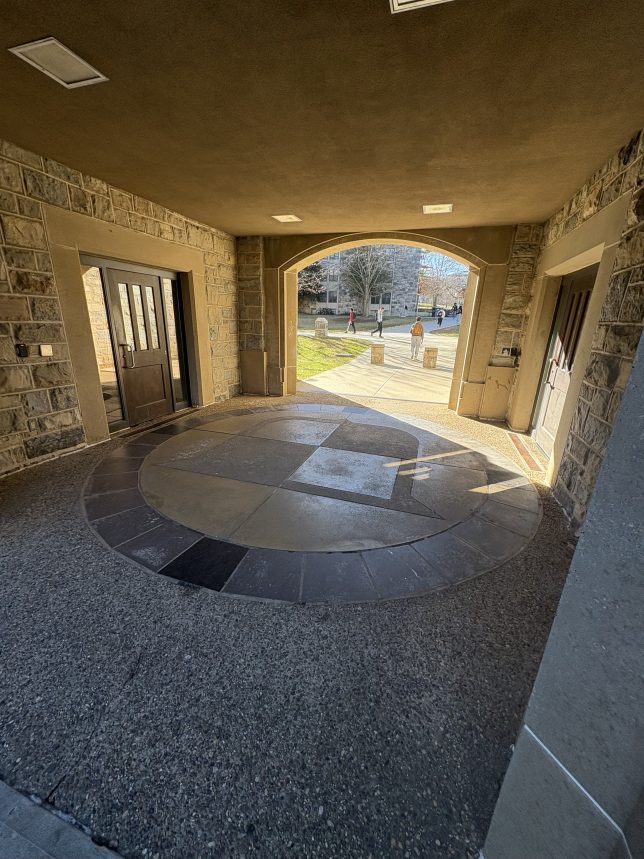
I call this Blacksburg’s Worst Walk. To most, this just seems like a nicely placed underpass But for me, this ruins my Sunday’s. Every week at 9 a.m., in order to do laundry, I have to cross through here and enter the door on the left. Why is this bad? Well, unfortunately, this underpass acts as a wind tunnel, rudely waking me up with a breeze so strong I have to brace myself each time I pass through. While it is sometimes refreshing, during this season, it annoys me. (90)
W is for War Memorial Chapel
2.28 War Memorial Chapel; Photograph and text; Thursday, Oct. 23rd
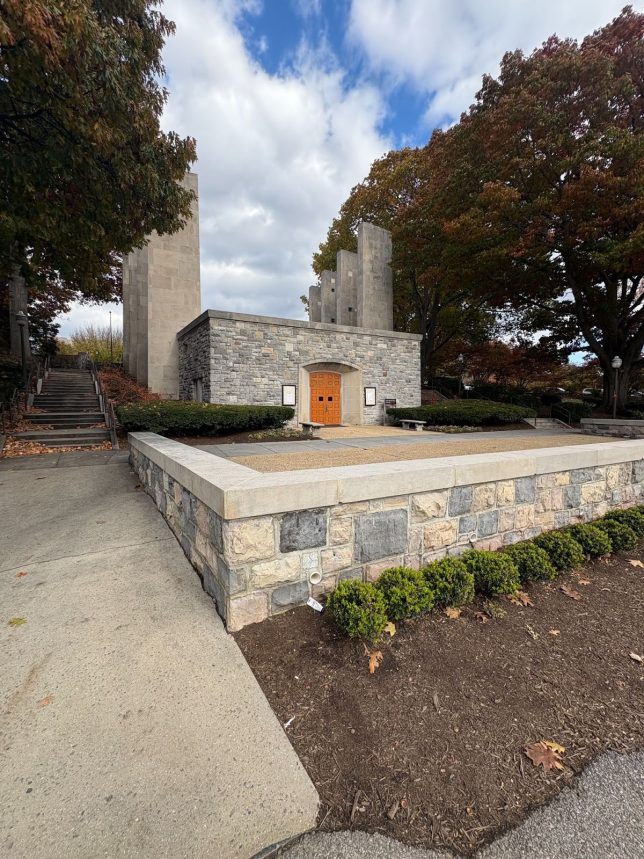
From the outside, the chapel looks strong and sturdy, built with gray Hokie Stone and perfect symmetry. It feels calm and grounded. But inside, the space feels extremely soft. The air is quiet and still, almost telling you to sit down, relax, think, and reflect. Plaques cover the walls, each name carved within, yet the room still feels empty. Nothing about it is loud. Details like the dim lighting, the soft steps from above, and the scent polished wood off gassing make it welcoming, but in a very soft way. (90)